Summary
Dedomena AI's OpenScore Neuron, exposed through the OpenScore API, evaluates an individual's credit risk using declared financial information and optional bank transaction history. It supports lending and risk-assessment workflows by returning a calculated credit_score, a default-risk category (low, medium, or high), the model confidence, and feature-level explanations.
The neuron combines core applicant data such as income, debt, rent or housing cost, total outstanding debt, employment seniority, and delinquency status. When transaction history is provided, the model enriches the assessment with behavioral signals such as income and expense patterns, account balance trends, and selected spending categories.
OpenScore also includes a credit acceptance endpoint for mortgage or credit operations. This endpoint evaluates operation details, lender, requested amount, term, interest rate, and one or two applicant profiles to predict whether the operation is likely to be accepted or denied.
Note: This classification is based on the probability of a user being in a certain level. It is essential to consider other factors and perform additional checks to confirm the user's score. Also, this algorithm runs on the fly, Dedomena AI does not store any data. You must copy the results to avoid losing the information.
Use the OpenScore Neuron to standardize applicant assessment, improve explainability in risk decisions, and integrate credit risk signals directly into digital lending workflows.
Key Properties
The system's functionality is built on several key innovations:
-
Simplified Input Requirements: Unlike other models, this system only requires basic financial data from the individual being assessed. Optional transaction history can be added to improve the analysis. The system can be connected securely to company or entity data sources, being implemented on-premise or through Dedomena's connectors.
-
Proprietary Anonymization: Sensitive data is protected through advanced, proprietary anonymization layers that ensure data security.
-
Ensemble Models: The data is processed through an ensemble of intelligent models that extract insights, categorize transactions into income and expense categories, segment users, and estimate future balances. These architectures are the result of years of research and provide superior performance.
-
OpenScore and Default Risk Models: The final scoring is determined by two proprietary models—one for OpenScore and another for payment default risk, which requires the requested loan amount. These models deliver explainable results, giving financial institutions confidence in their decision-making processes.
-
Scalability and Updates: The system ensures scalability and seamless integration through an API. It is designed for biannual updates with minimal steps to keep the models and algorithms current.
-
Automation and Explainability: Best practices in machine learning lifecycle management have been applied, including bias reduction through synthetic training data. Explainability tools provide transparency into the scoring and risk assessment processes.
Use Cases
Here are the key use cases for the Customer Scoring Neuron:
-
OpenScore and Approval: Assessing an individual’s creditworthiness and determining the terms of a potential loan based on their transactional history and scoring insights.
-
Risk Management: Evaluating the likelihood of payment default and taking proactive measures to mitigate potential losses.
-
Marketing Strategies: Optimizing marketing campaigns by targeting customers based on their scores, preferences, and behavior.
-
Customer Segmentation: Identifying customer segments and tailoring products and services to meet their specific needs.
-
Customer Relationship Management: Enhancing customer relationships by providing personalized experiences and offers based on their scores and resulting insights.
-
Predictive Insights: Generating insights into future balances and spending behavior to inform financial planning and decision-making.
-
Fraud Detection: Identifying potentially fraudulent users with a dedicated scoring level (1) and recommending actions to safeguard business operations.
-
Business Growth: Driving strategic growth by leveraging customer scores to improve marketing effectiveness, increase customer satisfaction, and expand financial services.
Dedomena AI’s Customer Scoring Neuron is the ultimate solution for financial institutions, enterprises, retailers, fintechs, among other companies in diferent sectors, seeking a comprehensive, secure, and innovative tool for customer evaluation and risk assessment.
API & Endpoints
The OpenScore neuron is exposed through the OpenScore API.
Base URL: https://openscore-credit-scoring-852411909563.europe-southwest1.run.app
All endpoints use the required query parameter token=<your-token>.
/v1/risk_scoring
POST/v1/risk_scoring?token=<your-token>&user_type=PERSON
Scores one person using declared financial data and optional transaction history. The response includes a credit score, a default-risk category (low, medium, high), model confidence, feature contributions, and a request_id.
Request body:
{
  "user_id": "user_123",
  "income": 2500,
  "debt": 350,
  "renta": 800,
  "debt_total": 15000,
  "working_time": 720,
  "moroso": 0,
  "transactions": [
    {
      "date": "2026-03-15",
      "amount": -4599,
      "description": "Supermarket purchase",
      "category": 181,
      "balance": 124500
    }
  ]
}
transactions is optional. Transaction amount and balance are expected in cents. Positive amounts represent income and negative amounts represent expenses.

Response:
{
  "user_id": "user_123",
  "credit_score": 0.359,
  "default_risk_category": "high",
  "prediction_confidence": 0.92,
  "feature_contributions": {
    "dti": -0.1023,
    "trx_income": 0.0812
  },
  "request_id": 12345
}
/v1/credit_acceptance
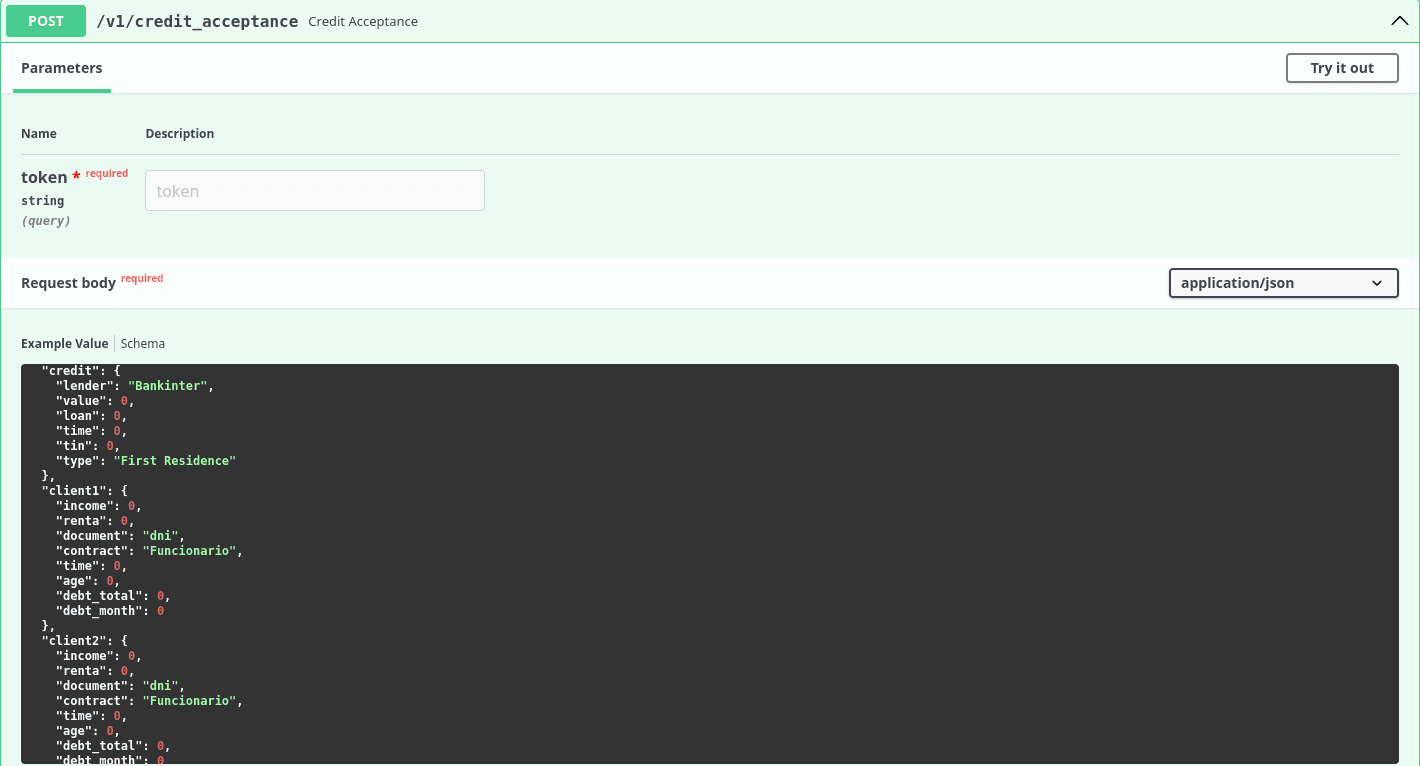
POST/v1/credit_acceptance?token=<your-token>
Predicts whether a credit operation is likely to be accepted.
Request body:
{
  "credit": {
    "lender": "Banco Sabadell",
    "value": 180000,
    "loan": 80000,
    "time": 30,
    "tin": 3.0,
    "type": "First Residence"
  },
  "client1": {
    "income": 7000,
    "renta": 120000,
    "document": "nie",
    "contract": "Funcionario",
    "time": 0,
    "age": 22,
    "debt_total": 5000,
    "debt_month": 50
  }
}
client2 can be added with the same structure as client1. The response returns prediction (1 = accepted, 0 = denied), probability, and request_id.
/v1/credit_acceptance/feedback
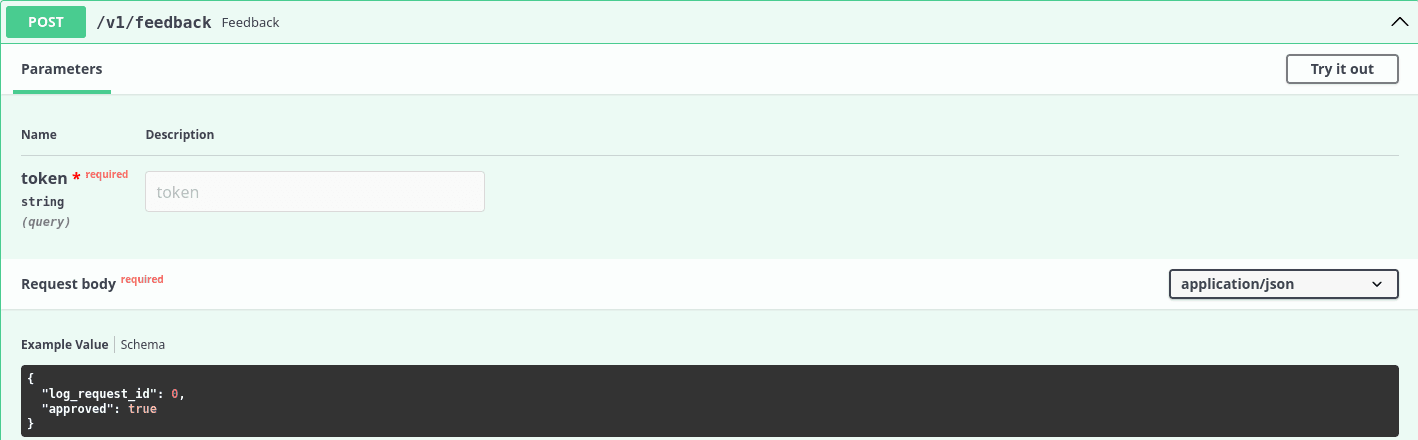
POST/v1/credit_acceptance/feedback?token=<your-token>
Submits feedback for a previous credit acceptance request. Use the request_id returned by /v1/credit_acceptance as log_request_id.
Request body:
{
  "log_request_id": 12345,
  "approved": true
}
approved=true stores the feedback as approved. approved=false stores the feedback as rejected.
Response:
{
  "log_request_id": 12345,
  "feedback": "approved",
  "status": "updated"
}
/predict_home_insurance
POST/predict_home_insurance?token=<your-token>
Predicts the home insurance premium from the bank and property appraisal.
Request body:
{
  "bank": "Sabadell",
  "appraisal_amount": 0
}
Response:
"string"
The returned string can be "true" or "false".
/predict_life_insurance
POST/predict_life_insurance?token=<your-token>
Predicts the life insurance premium from mortgage and applicant details.
Request body:
{
  "bank": "Sabadell",
  "mortgage_amount": 0,
  "age": 0,
  "applicants_count": 0
}
Response:
"string"
The returned string can be "true" or "false".